
Unlocking Market Intelligence:
How to Use Radius Demographic Reports for Site Selection
In today’s competitive business landscape, understanding your local market is no longer optional—it’s essential. Whether you’re a real estate professional evaluating properties, a business owner planning a new location, or a marketer developing targeted campaigns, demographic data provides the foundation for informed decision-making. Radius demographic reports offer a powerful lens into the communities surrounding any given location, revealing insights that can make or break your business strategy.
Let’s explore a real-world example using demographic data from 2875 Milwaukee Avenue in Northbrook, Illinois, to demonstrate how you can extract actionable insights from radius reports.
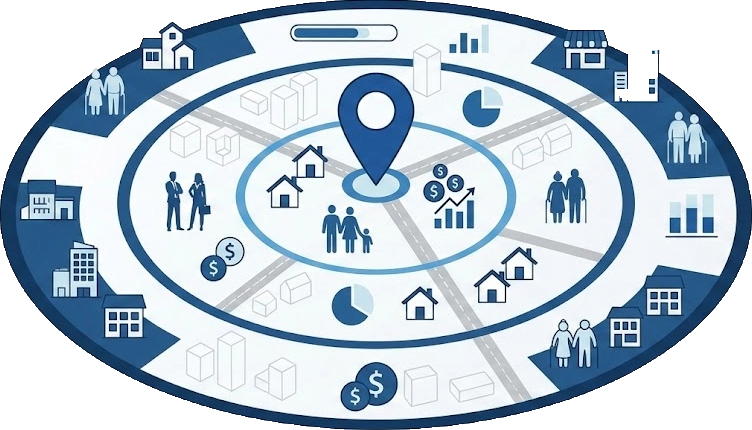
Understanding the Power of Multi-Radius Analysis
Demographic reports typically analyze three concentric circles around your target location—commonly 1, 3, and 5 miles. This multi-layered approach reveals crucial patterns about immediate neighbors versus the broader community. For our Northbrook example:
- 1-mile radius: 12,277 residents in 4,466 households – your immediate customer base
- 3-mile radius: 94,162 residents in 36,330 households – your primary trade area
- 5-mile radius: 302,932 residents in 117,685 households – your extended market reach
Notice how the immediate 1-mile radius shows notably different characteristics from the broader 3- and 5-mile zones. This variation tells a story about neighborhood evolution and opportunity.
Income Analysis: Identifying Your Target Market
Household income data reveals purchasing power and helps you position your business appropriately. The Northbrook location shows fascinating income dynamics:
| Radius | Median Income | Over $200K Households |
| 1 mile | $82,821 | 5.8% |
| 3 miles | $127,436 | 24.1% |
| 5 miles | $121,953 | 22.1% |
Key Insight: The immediate 1-mile area has a significantly lower median income than the surrounding regions, but this doesn’t tell the whole story. Look deeper at the distribution: while the 1-mile radius shows more modest overall incomes, the 3-mile zone reveals substantial wealth concentration with nearly a quarter of households earning over $200,000 annually. This suggests an opportunity for businesses that can appeal to both value-conscious immediate neighbors and affluent customers willing to travel a short distance.
Age Demographics: Targeting Life Stages
Understanding the age composition helps you tailor your products, services, and marketing messages. The Northbrook data reveals a mature, established community:
- Median age in the 1-mile radius: 38.5 years (35.5 for males, 41.4 for females)
- Median age in the 3-5 mile radius: 42.5+ years, indicating established families and professionals
- Prime working-age population (25-54): Represents 45-55% of males and 44-52% of females across all radii
Application: If you’re opening a family-oriented business, this demographic profile is ideal. The substantial 35-54 age cohort indicates families in their peak earning and spending years. However, the growing 65+ population (20-24% across the broader radii) also presents opportunities for senior-focused services, healthcare, or leisure activities.
Education Levels: Gauging Market Sophistication
Educational attainment often correlates with income, career paths, and consumer preferences. The Northbrook area shows strong educational achievement:
- 3-mile radius: 61.1% hold college degrees or higher (bachelor’s through doctorate)
- 5-mile radius: 60.6% college-educated population
- Graduate/professional degrees: 24.2% (3-mile) and 23% (5-mile) hold advanced degrees
This highly educated population typically values quality, expertise, and specialized services. They’re likely to research purchases carefully and appreciate businesses that demonstrate knowledge and professionalism.
Housing Data: Understanding Stability and Wealth
Home values and ownership rates indicate community stability and accumulated wealth. The Northbrook location sits in a predominantly owner-occupied area:
- Homeownership rate: 52.5% within 1 mile, rising to 69.7% at 3 miles and 74.7% at 5 miles
- Median home values in the 3-5 mile radius: Concentrated in the $300K-$750K range, with 42% of homes valued between $500K-$1.5M
- Mortgage status: 56-59% of homeowners carry mortgages, with 43-44% owning homes outright
Real Estate Insight: The high homeownership rate and substantial home values indicate a stable, affluent community with significant equity. The 40%+ mortgage-free rate suggests many long-term residents or retirees with considerable discretionary income. This combination creates ideal conditions for home improvement services, luxury goods, and premium service providers.
Commute Patterns: Timing Your Business Operations
Understanding how people get to work and when they’re available helps optimize your business hours and location accessibility:
- Primary transportation: 74-88% drive to work, with 67-74% driving alone
- Work-from-home population: 16.5-17.3% in the 3-5 mile radius (significantly above national averages)
- Commute times: Most residents (40-47%) have commutes under 20 minutes, with another 25-29% commuting 20-34 minutes
Business Strategy: The high work-from-home percentage creates midday traffic opportunities that many suburban areas lack. Combined with short commute times, this suggests residents are often local during traditional working hours—ideal for service businesses, lunch spots, or convenience retail that can capture both remote workers and those with flexible schedules.
Diversity and Cultural Considerations
The Northbrook area shows notable ethnic and cultural diversity that affects market opportunities:
- 1-mile radius: Highly diverse with 36.6% Hispanic/Latino population, 14.3% Asian, and 49.4% White
- 3-5 mile radius: More homogeneous with 61-66% White, 17-21% Asian, and 14-15% Hispanic/Latino populations
This diversity gradient from the immediate area to the broader region suggests opportunities for culturally-specific businesses in the 1-mile zone, while businesses in the extended radius might focus on broader appeal with multicultural sensitivity.
Practical Applications by Industry
For Retail Business Owners
- Immediate area (1-mile): Position as a neighborhood convenience destination serving diverse, working families with mid-range income
- Extended area (3-5 miles): Market premium products to affluent, educated consumers willing to drive for specialty items
- Vehicle ownership: With 90%+ of households having vehicles, ensure ample parking
For Real Estate Professionals
- Property positioning: Homes in the 3-5 mile radius command premium prices ($500K-$750K sweet spot)
- Target buyers: Educated professionals (60%+ college-educated) in their 30s-50s seeking stable, family-friendly communities
- Rental market: 25-48% renter-occupied units with strong demand for 1-2 bedroom apartments at $1,250-$2,000/month
For Service Businesses
- Professional services: High education levels create demand for financial planning, legal services, and specialized consulting
- Home services: Aging housing stock (many homes built 1960-1979) combined with high home values creates renovation and maintenance demand
- Healthcare: Growing 65+ population (20-24%) indicates increasing demand for senior care and medical services
How to Extract Maximum Value from Your Report
1. Compare Radii for Pattern Recognition
Don’t just look at one radius in isolation. The differences between your 1-mile, 3-mile, and 5-mile data tell you about neighborhood transitions, gentrification trends, and market segmentation opportunities. In the Northbrook example, the income and diversity differences between the immediate area and broader region reveal distinct customer segments requiring different approaches.
2. Cross-Reference Multiple Data Points
Income alone doesn’t tell the full story. Combine it with education, home values, age, and commute patterns for deeper insights. High income + high education + high home values + work-from-home = affluent professionals who value convenience and quality—a very different market than high income + low education + long commutes.
3. Look Beyond Medians to Distributions
The Northbrook 1-mile radius has a median income of $82,821, but 16% of households earn over $150,000. If you only focused on the median, you’d miss a significant affluent segment. Always examine the full income distribution to identify underserved niches.
4. Consider Temporal Factors
Housing data shows when people moved in and when buildings were constructed. This reveals community stability, turnover rates, and potential renovation needs. In Northbrook, many homeowners moved in 2010-2017, suggesting they’re now 8-15 years into homeownership—prime time for major renovations or upgrades.
5. Map Lifestyle Indicators
Vehicle ownership, internet connectivity, and computer access reveal lifestyle and consumption patterns. The Northbrook area’s 92% broadband penetration and 91% smartphone ownership indicate a digitally-savvy population responsive to online marketing and e-commerce options.
Turning Data Into Action
Radius demographic reports transform raw census data into strategic intelligence. They answer critical questions:
- Who lives here?
- What can they afford?
- What are their daily patterns?
- How stable is the community?
- What opportunities exist?
Whether you’re selecting a retail location, pricing a property, targeting a marketing campaign, or planning a new service offering, demographic intelligence removes guesswork from your decision-making process. The data doesn’t just describe a location—it reveals the people, their resources, their needs, and their behaviors.
The Northbrook example demonstrates that successful market analysis goes beyond surface-level statistics. By examining how different data points intersect and how they vary across distances from your target location, you develop a nuanced understanding that can give you a significant competitive advantage.
Ready to unlock the insights hidden in your target location? A comprehensive radius demographic report is your first step toward data-driven success. The demographics don’t just paint a picture of where you might do business—they reveal exactly who you’ll serve and how to reach them effectively.
Get your custom radius demographic report today and make your next business decision with confidence.
Learn More About Using Demographics for your Business Success

Tracking Demographic Trends Can Be a Look Into the Future
Tracking Demographic Trends Can Be a Look Into the [...]
Why Smart Franchise Owners Stop Guessing and Start Using Radius Demographic Mapping
Why Smart Franchise Owners Stop Guessing and Start Using [...]

How to Find Population Inside a Radius (And Why It’s Your Secret Weapon)
How to Find Population Inside a Radius (And Why [...]